
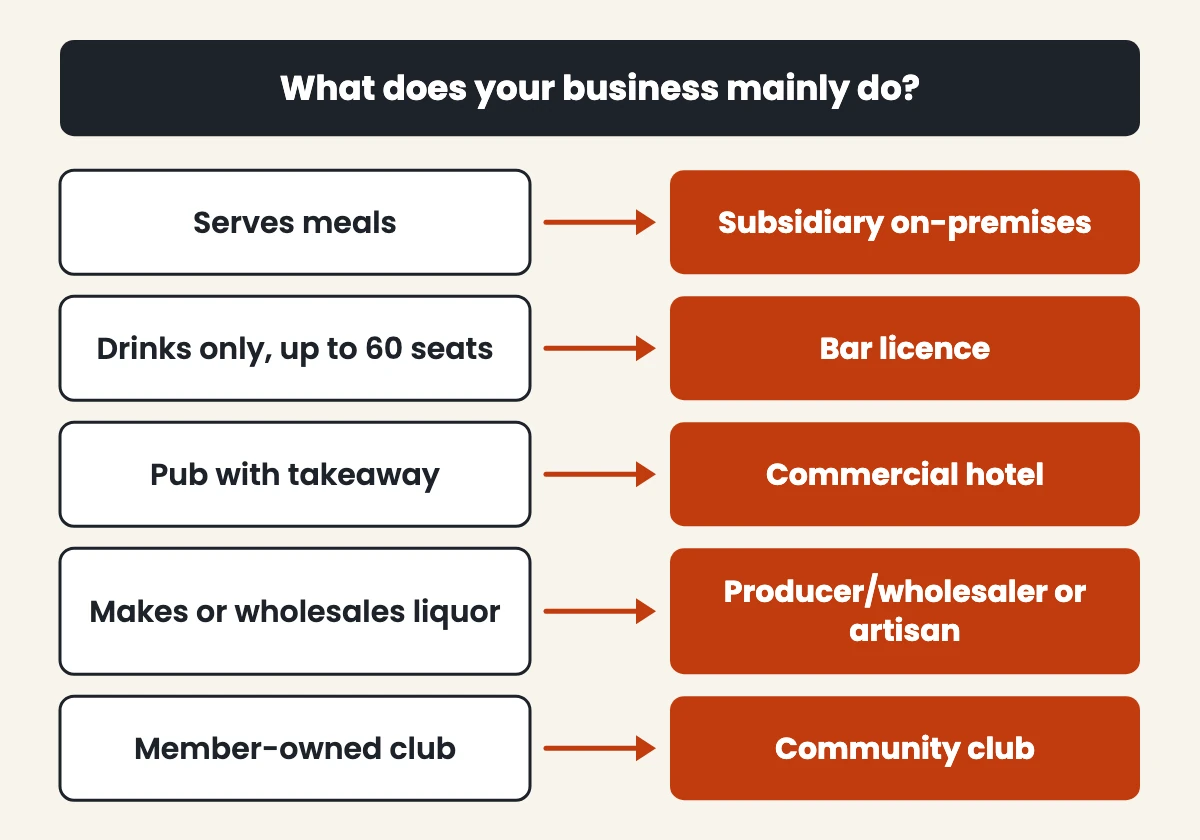
Queensland has six liquor licences under the Liquor Act 1992: commercial hotel, commercial special facility, commercial other, community club, community other and nightclub. The commercial other licence then splits into six types, and wineries are licensed separately under the Wine Industry Act 1994. Which one you need depends on what your business mainly does, not on what you call it.
The Office of Liquor and Gaming Regulation (OLGR) decides the licence by looking at your principal activity. A cafe that sells wine with lunch, a 50-seat cocktail bar and a pub with a bottle shop each sell alcohol, but each fits a different licence with different rules about who can drink, where and how much can leave the premises.
Key takeaways
- Start with what your business mainly does. Meals first usually points to a subsidiary on-premises licence; drinks first in a small venue points to a bar licence.
- A bar licence covers on-premises drinking only, in a venue that seats no more than 60 people at a time.
- A pub or tavern with a bottle shop needs a commercial hotel licence, which needs a commercial kitchen, more than 60 seats and at least two of a dining area, three or more guest rooms or a function room.
- Breweries, distilleries and wholesalers have their own producer licences, and wineries are licensed under the Wine Industry Act 1994.
- Clubs owned by their members use a community club or community other licence, and one-off events usually need a permit rather than a licence.
The licence types Queensland offers
Section 58 of the Liquor Act 1992 lists the licences OLGR can grant. Section 66 then sets out the six types of commercial other licence, which covers restaurants, cafes and small bars.
| Licence | Who it is built for | What it allows, in short |
|---|---|---|
| Commercial hotel | Hotels and taverns | Drinking on site and takeaway, with meals, accommodation or functions as part of the business |
| Commercial special facility | Casinos, airports, convention centres and other major tourism businesses | Licensed for a facility that contributes significantly to Queensland tourism; sporting facilities are excluded |
| Commercial other: subsidiary on-premises | Restaurants, cafes, motels, theatres, function centres, vessels and similar | Alcohol as a side part of another main activity, mostly for drinking on site, with limited takeaway such as a diner's bottle of wine |
| Commercial other: subsidiary off-premises | Florists and gift basket businesses | Alcohol sold as a side part of the business, taken away |
| Commercial other: bar | Small bars | Drinking on site only, in a venue seating no more than 60 |
| Commercial other: industrial canteen | Remote mining, road or rail construction camps | Sales to people working at the site, their families and guests |
| Commercial other: producer/wholesaler | Liquor makers and wholesalers | Production and wholesale, with limited sales to the public |
| Commercial other: artisan producer | Craft brewers and distillers within set volumes | Production with sales to the public allowed |
| Community club | Member-owned clubs such as sporting clubs and RSLs | Members, guests, reciprocal members and visitors, on and off site for members |
| Community other | Member-owned clubs that trade on set hours all year | Set hours, up to 25 hours a week |
| Nightclub | Venues where live entertainment is the main activity | Drinking on site while the entertainment runs |
Only one Liquor Act licence can be held for the same premises, or the same part of a premises (a wine licence under the Wine Industry Act 1994 can sit alongside it), so the choice matters before you lodge.
Match your business to a licence
Cafes, restaurants and other businesses where alcohol is a side line
A subsidiary on-premises licence is for businesses where selling alcohol to drink on site supports something else, such as meals, accommodation, a show or a function. Business Queensland's list of licence types names restaurants, cafes, motels, vessels, indoor sporting centres, theatres, amusement parks, function centres and training institutions as examples.
If meals are the main activity, section 67A of the Act adds tests that apply every trading day:
- most patrons eat a meal on the premises
- most of the floor is set up with tables and seating for eating
- the kitchen stays open until 1 hour before closing
- there are enough staff to prepare and serve meals.
Diners may also take home 1 opened and 1 unopened bottle of wine with their meal. If you are planning a restaurant or cafe, our restaurant and cafe liquor licence checklist walks through what to prepare for this licence.
Small bars where the drinks are the main event
A bar licence suits a venue where selling alcohol is the main activity and the premises can seat no more than 60 patrons at any one time (section 70). It covers drinking on the premises only. There is no takeaway under a bar licence, so a small bar that also wants to sell bottles to go is looking at a different licence.
Pubs, taverns and venues with a bottle shop
A commercial hotel licence lets the licensee sell alcohol on the premises for drinking there or taking away. In return, Business Queensland says the venue needs:
- a commercial kitchen
- at least 2 of: a dining or bistro area, self-contained accommodation with at least 3 rooms, or a function room for hire
- seating for more than 60 patrons, with adequate toilets.
A commercial hotel can also apply to run up to 3 detached bottle shops away from the main premises. Hotels, nightclubs and commercial special facilities also face extra consultation in their community impact statement, so these applications take more preparation than most.
Late venues built around entertainment
A nightclub licence is for businesses whose main activity is entertainment, with drinks sold while it runs. The entertainment has to be provided by a person on site, such as a DJ, band or performer. A jukebox or pool tables do not count.
Breweries, distilleries, wineries and wholesalers
Makers and wholesalers have three routes:
- Producer/wholesaler licence: production and wholesale are the main activity, including selling to other licensees, with limited sales to the general public.
- Artisan producer licence: for craft brewers producing at least 2,500 L of beer a financial year on the premises and no more than 5 million L a financial year across the business, or distillers producing at least 400 L of spirits a financial year and no more than 450,000 L a financial year across the business, with sales to the public allowed.
- Wine producer or wine merchant licence: issued under the Wine Industry Act 1994 for vineyards, wineries and businesses that make or blend wine elsewhere.
Sporting clubs, RSLs and associations
A community club licence is for non-proprietary clubs, meaning clubs owned by their members, such as sporting clubs and RSLs. It allows sales to members, their guests, reciprocal members and bona fide visitors, and members can take alcohol away. A community other licence suits a member-owned club that trades on set hours all year round, up to 25 hours a week.
Florists, gift baskets and remote work camps
A subsidiary off-premises licence covers alcohol sold as a side part of a business and taken away, such as a florist or gift basket seller. An industrial canteen licence covers sales to people working at remote mining, road or rail construction sites with no permanent population, and to their families and guests.
When you may not need a licence at all
Some businesses can supply a small amount of alcohol without a licence, under sections 14A and 14B of the Liquor Act. OLGR's exemption guidance covers hairdressing salons, limousines and tour operators (each limited to 2 standard drinks per person per day, with set days, and for limousines and tours set hours, when no alcohol can be served), gift baskets and flowers within stated limits, bed and breakfasts with no more than 8 guests, host farms, hospitals, nursing homes and retirement villages.
Events are different again. A fundraising event run by a non-profit group can be exempt under section 13 of the Act when it meets set conditions, such as all net proceeds going to the community and drinks sold in open containers between 7am and midnight. Otherwise, a one-off festival, market or fundraiser usually runs under a permit rather than a licence: a commercial public event permit for an existing licensee catering the event, or a community liquor permit for a club or a community group whose net proceeds go to the community. Our temporary liquor permits page covers which permit fits.
What OLGR looks at once you have picked a type
Choosing the type is the first step, and our new liquor licence applications page explains how we prepare the rest. OLGR then asks for the application form for that licence, a risk-assessed management plan in most cases (Business Queensland's RAMP guidance), and a community impact statement for new licence applications other than a community other licence, with some exemptions for restaurants and cafes that meet set conditions (OLGR's community impact statement guidance). You may also need to advertise the application outside the premises.
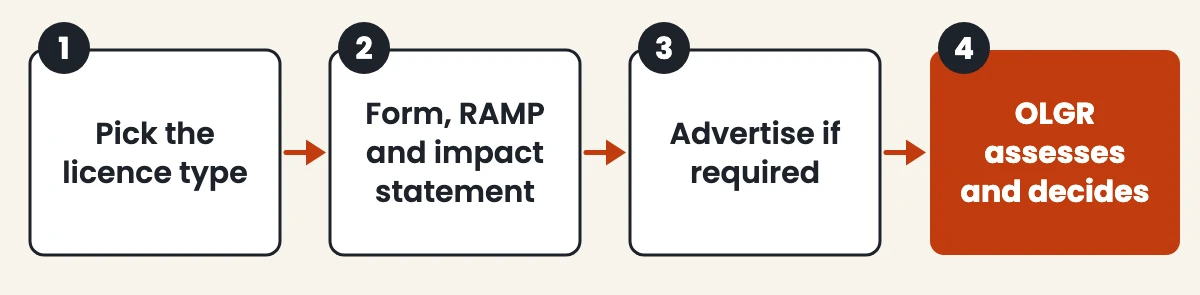
OLGR assesses whether the applicant is a fit and proper person, whether the premises suit the licence, the likely community impact and any objections. Business Queensland's guide to the application process says most new applications are finalised in around 3 months when everything is lodged and there are no issues. We cannot promise a timeframe or an outcome, but a complete, well-prepared application avoids the delays that come from requests for more information.
Not sure which licence fits your venue? Tell us what you are opening, your seating, your trading hours and whether you want takeaway. We will match it to the right licence type and prepare the application, the risk-assessed management plan and the community impact statement with you.
What if your business changes later?
Your business may grow into a different licence. A cafe that becomes a late-night bar, or a bar that wants a bottle shop, may no longer fit the licence it holds, because the licence follows the principal activity. Changes to a licence, its licensed area or its conditions go through OLGR as their own applications. Our liquor licence changes page explains how we handle them, and it is worth raising your longer-term plans at the start so the first application does not box you in.
Frequently asked questions
What are the main types of liquor licence in Queensland?
The Liquor Act 1992 lists six licences: commercial hotel, commercial special facility, commercial other, community club, community other and nightclub. The commercial other licence has six types: subsidiary on-premises, subsidiary off-premises, bar, industrial canteen, producer/wholesaler and artisan producer. Wine producers and merchants are licensed under the Wine Industry Act 1994.
Which liquor licence does a cafe or restaurant need?
Most cafes and restaurants apply for a commercial other subsidiary on-premises licence, where meals are the main activity and alcohol is a side part of the business. The meals tests in section 67A apply every trading day. Our restaurant and cafe checklist covers what to prepare.
Can a small bar sell takeaway alcohol?
No. A bar licence allows drinking on the premises only, in a venue seating no more than 60 people. Takeaway sales sit with other licences, such as a commercial hotel licence.
What licence does a pub with a bottle shop need?
A commercial hotel licence. It allows drinking on site and takeaway, and the licensee can apply to run up to 3 detached bottle shops. The venue needs a commercial kitchen, more than 60 seats and at least 2 of a dining area, 3 or more guest rooms or a function room.
Do breweries and distilleries need a different licence?
Yes. A producer/wholesaler licence suits businesses that mainly make or wholesale liquor, with limited public sales. An artisan producer licence suits craft brewers and distillers within set yearly volumes and allows sales to the public. Wineries apply under the Wine Industry Act 1994.
Do I need a liquor licence to give customers a drink?
Not always. Hairdressing salons, limousines and tour operators can supply up to 2 standard drinks per person per day under an exemption, and gift baskets, small bed and breakfasts and host farms have their own limits. Anything beyond those limits needs a licence or permit.
This guide is general information about Queensland liquor licence types, current at 19 November 2026 from the Liquor Act 1992 and Business Queensland guidance from OLGR. It is not legal advice, and the right licence for your business depends on your premises, plans and trading hours.
Ready to apply? At QLD Liquor Licence Specialists, we prepare liquor licence applications across Queensland and deal with OLGR on your behalf, from the first form to the final decision. Call (07) 41207747 or book a free initial consult and we will tell you which licence fits and what the application will need.
You can also find us on Google.